
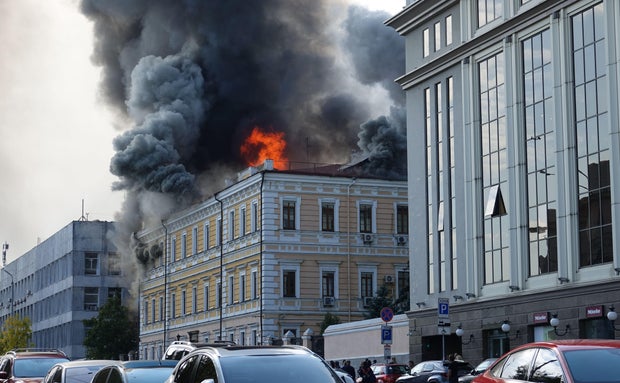
Kyiv, Ukraine — A series of relentless Russian attacks on Ukraine resulted in the deaths of at least seven individuals and injuries to over 50 others, according to officials. On Monday, Moscow targeted apartment complexes, business offices, data centers, and the National Academy of Sciences of Ukraine located in central Kyiv. The daytime assault signifies a bold continuation of hostilities.
Aidan Stretch from CBS News found himself seeking shelter soon after arriving at the impacted site at the Academy of Sciences due to further Russian weaponry arriving. Fires and smoke were observed rising from the building, hit by a Russian drone on September 28, 2026.
This offensive occurs after a week dominated by diplomatic initiatives within the United Nations, aimed at generating momentum for discussions to halt Moscow’s expansive invasion, which has persisted for 4.5 years. Kremlin spokesperson Dmitry Peskov noted that prospects for rapid progress in peace negotiations appear dim, owing to recent attacks by Ukraine, even during Russia’s parliamentary elections.
Peskov commented to reporters, “Ukraine will face consequences for the actions undertaken over recent months. This is unfolding currently.”
On Saturday, Russian Foreign Minister Sergey Lavrov, in a vehement address to the U.N. General Assembly, accused Europe of impeding peace negotiations desired by the Trump administration, continuing Moscow’s strategy to depict fissures within NATO.
Intensified Russian Drone Strikes on Ukraine
Russian drone strikes across the Kyiv region led to four fatalities and eight injuries. Officials reported that a woman perished due to a strike in Kyiv’s Shevchenkivskyi district, affecting the National Academy of Sciences—a cultural site in the capital city. Additional targets included a pharmaceutical corporation and local gas stations.
In Dnipro, an office center was struck during work hours on Monday, resulting in three deaths and at least 12 injuries, as confirmed by local authorities. Meanwhile, a Russian attack on a nine-story apartment complex in Kharkiv injured 43 people, among them 11 children, detailed by Mayor Ihor Terekhov.
On Sunday evening in Chernihiv’s northern region, four individuals, inclusive of two teenage girls, were injured due to a drone hitting a residential area, stated Viacheslav Chaus, regional military administration head.
Russia’s Defense Ministry confirmed attacks on two data centers in Kyiv along with several gas stations. Additionally, a Nova Poshta postal service distribution facility in Odesa was also targeted. The Ministry further disclosed strikes on a cargo ship within the Black Sea and another ship at Ukraine’s port in Chornomorsk, intended to disrupt Ukraine’s grain exports, potentially causing food shortages in nations reliant on these imports. Despite Moscow’s claims of targeting military assets solely, civilian areas are repeatedly affected.
Ukraine’s Ongoing Military Campaign
Battlefield dynamics have largely remained unchanged over the past year, due partly to the significant drone presence limiting troop mobility. Kyiv initiated an offensive named Operation Vivaldi along portions of the extensive 800-mile front line. The Third Army Corps of Ukraine announced regaining 20 square miles from Russian control, totaling 68 square miles since the operation’s inception.
For breaking through Russian defenses, Soviet-era BTR-60 armored vehicles were transformed into kamikaze units to obliterate fortified enemy positions. Ground robots further contributed to attacks on Russian strongholds. These successes are reportedly in Donetsk, where the formidable Russian military has struggled for dominance.
Although Russian representatives have not provided a reaction to these developments, the Russian Defense Ministry indicated capturing Novovodiane in Donetsk and Ulanove in northern Sumy. Verification of these assertions remains outside independent reach.
President Zelenskyy noted successful long-range strikes within Russian territory, hitting defense plants in Tula and Voronezh regions and oil infrastructure in Krasnodar, all across southern and western Russia. Ukrainian drones have targeted Russian fuel reserves and industrial centers central to Russia’s economic and wartime activities.
On Monday, emergency services in Russia’s Krasnodar region confirmed overnight Ukrainian drone-generated fires at three distinct infrastructure locations, although specifics were undisclosed. Meanwhile, Russia’s Defense Ministry reported the interception of 254 Ukrainian drones overnight.