
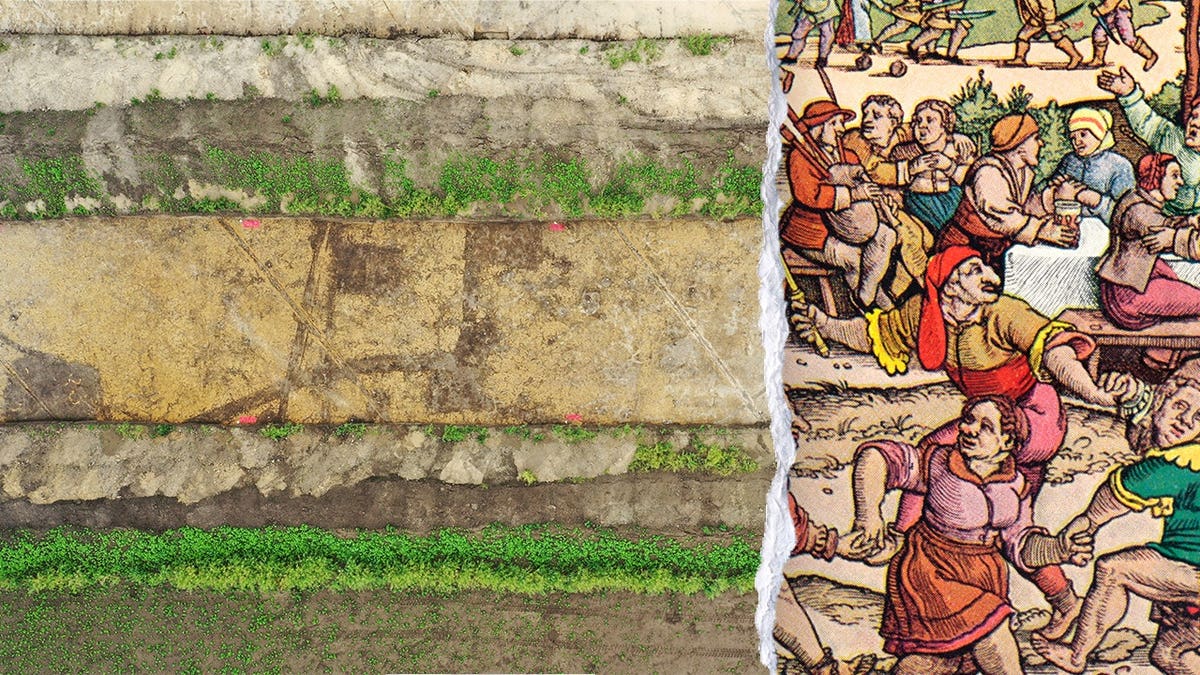
Archaeologists have recently discovered the remains of a medieval village in Germany, raising questions about why it was mysteriously deserted by its inhabitants. The excavation took place at the Am Frevelgraben site in Halberstadt, located in Saxony-Anhalt, where researchers found numerous traces of the settlement, including a complex ditch system.
Excavation and Findings
The State Office for Monument Preservation and Archaeology Saxony-Anhalt announced the findings on August 24. Excavations commenced in March as part of preparations for a nearby industrial park. Historical records suggest the site might be the village known as Kühlingen.
At the site, archaeologists documented rows of pit houses, settlement pits, and two wells. Evidence also suggests that the village residents utilized the nearby riverbank extensively. The overlapping features and proximities of the houses imply that the settlement experienced two distinct developmental phases.
Lack of Artifacts and the Mystery of Abandonment
The preservation of the settlement’s remains was remarkable. However, the archaeologists found a surprising scarcity of artifacts. The few items discovered included scattered ceramic shards, metal finds such as a bronze tap, fittings, and belt buckles. Oliver Dietrich, spokesperson for the State Office for Heritage Management and Archaeology Saxony-Anhalt, noted the striking absence of artifacts, typical for deserted medieval villages.
The excavation provided no signs of destruction or fire. The reasons for the site’s abandonment remain unknown. Dietrich stated that the organized nature of the village’s desertion is unusual and remains unexplained.
Ongoing Research
Further analysis is expected to shed light on why the village was abandoned. The researchers plan to use radiocarbon dating on selected animal bones to pinpoint when exactly the site was deserted. The village is one of many medieval sites discovered across Germany, with the 14th and 15th centuries being a significant period of abandonment due to the Black Death, migration, and resource scarcity.
The discovery in Germany follows another recent find. Earlier this year, researchers uncovered Stolzenberg, an abandoned medieval settlement in a remote Polish forest.