
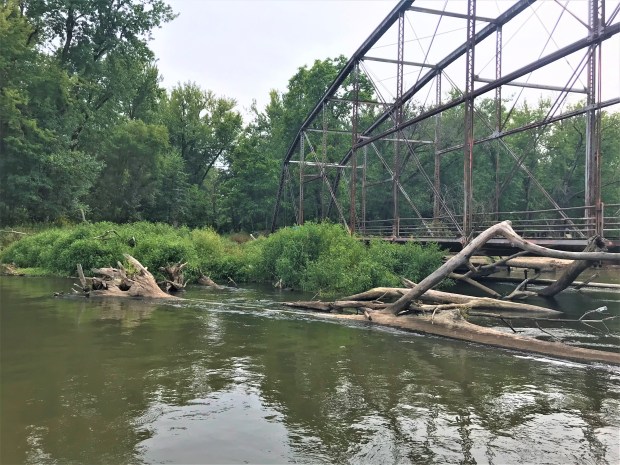
The State Line Bridge, which has been a longstanding obstruction on the Kankakee River, is set to be removed. Built in 1926 and now decommissioned, the bridge is more accessible to debris than to people. It spans the Indiana-Illinois state line, hanging low enough to trap heavy debris, leading to frequent flooding. The bridge’s low position and location make clearing logjams challenging.
The Kankakee River Basin and Yellow River Basin Development Commission recently received the final federal permit for the bridge’s long-anticipated removal. This $2.5 million project is slated to begin in the fall and conclude by December. The removal process entails using two cranes positioned on each side of the river, dismantling the bridge piece by piece, then labeling and storing the parts for potential future reassembly.
Scott Pelath, the Commission’s Executive Director, emphasized the bridge’s historical significance. He assured that the operation is not about salvaging materials; rather, it’s about preserving the bridge’s historical essence for any community or group interested in reconstructing this engineering marvel.
Butler, Fairman and Seufert, an engineering firm, devised a plan to remove the bridge using cranes atop a temporary causeway. In June, F.H. Paschen was chosen to execute the removal. Funding for the project is fully secured, according to Pelath.
The Commission, established in 2019, has prioritized the State Line Bridge’s removal. The bridge’s unique position above the river causes continuous debris accumulation, but its location is what truly complicates debris removal.
Pelath remarked, “The challenge isn’t only the debris trapping but the bridge’s location. This position makes it impossible to clear blockages during a flood when water movement is crucial.”
John McNamara, Chair of the Commission and a former St. Joseph County surveyor, shared similar sentiments. Having dreamed of removing the bridge since the late 1970s, he recalls, “The bridge has stalled high water each flood season for almost thirty years.” According to McNamara, this decision marks a crucial turn, with the actual crane operation eagerly anticipated.
Rob Churchill, a Newton County Commissioner and local farmer, echoed this sentiment. The bridge’s removal is seen as a pivotal change for local agriculture. “As farmers, we’ve long worried about drainage issues caused by the bridge,” he stated. “The removal will drastically improve our situation.”
Pelath acknowledged the significant contributions of the U.S. Army Corps of Engineers and Indiana officials in securing a preservation agreement. This agreement both safeguards the historic value and supports the flood-control initiative.
This article was reported by Doug Ross for the Post-Tribune.