
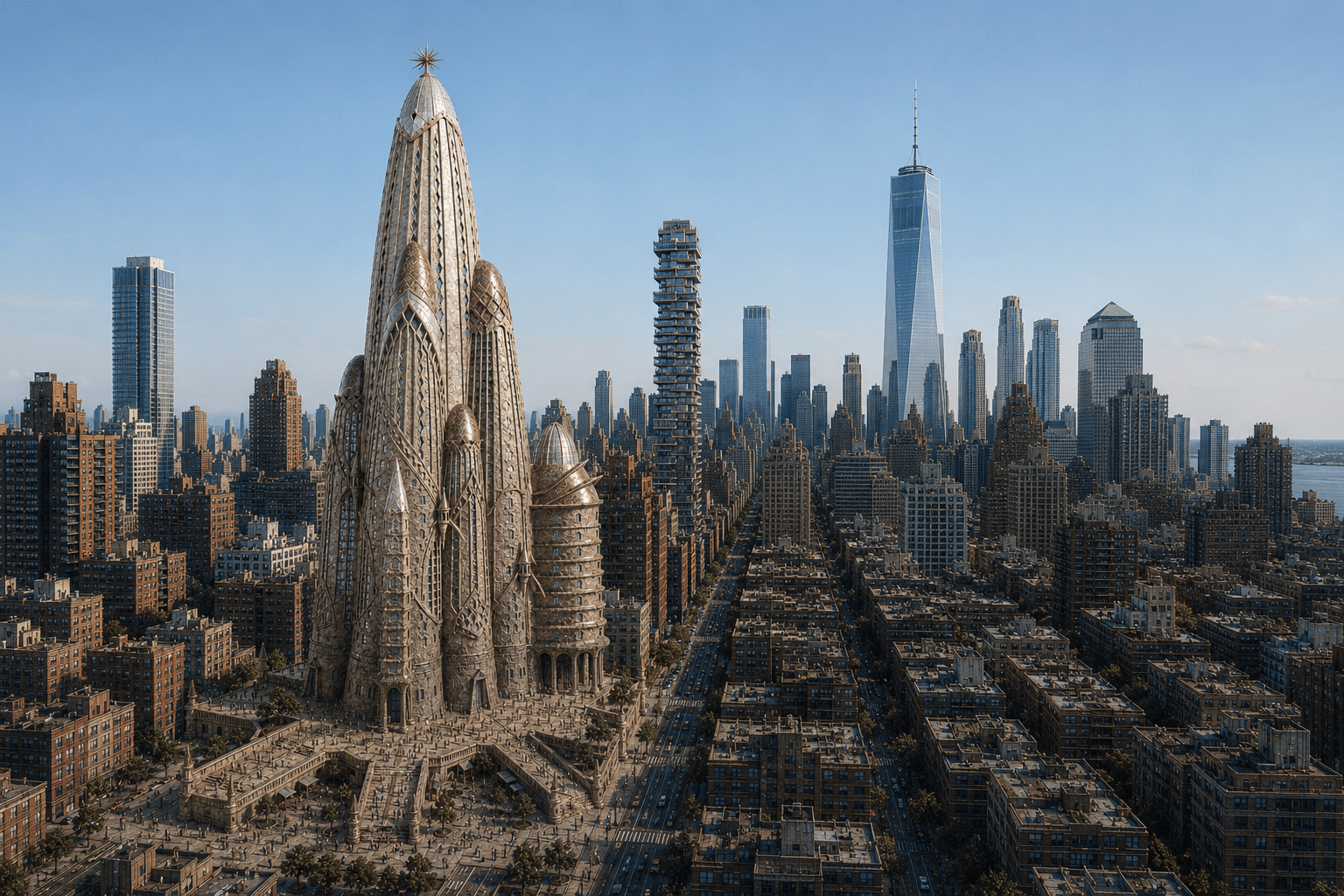
A once-forgotten skyscraper envisioned for New York City by Antoni Gaudí has been reborn through detailed visualizations. This project reveals what might have been one of the most extraordinary buildings ever imagined. Named Hotel Attraction, it was designed by Gaudí at the behest of two unknown American businessmen in 1908. Journalist Daniel Coughlin has revived this concept on his YouTube channel, The Curious Compendium of Architectural What-Ifs.
Unlike previous depictions that focused mainly on the striking exterior, Coughlin’s recent work delves into the complex interiors of Hotel Attraction. These include vast ceremonial halls, themed cultural spaces, and monumental chambers. If constructed, this structure would have reached approximately 1,181 feet in height, dominating Lower Manhattan’s skyline until the Empire State Building surpassed it in the 1930s.
Gaudí’s death centenary renews interest in Hotel Attraction. He passed away on June 10, 1926. His most famous project, Sagrada Família in Barcelona, continues to be built over 140 years since it began in 1882. This year saw the addition of a cross to its highest tower, marking progress toward making it the world’s tallest church.
A Vertical World of Themed Halls
Coughlin explored how Hotel Attraction might fit into modern-day Lower Manhattan, specifically on Church Street. He wanted to present it as a real possibility rather than science fiction. Gaudí envisioned it as a combination of a hotel, cultural complex, and secular cathedral.
Surviving descriptions indicate visitors would enter through one of four monumental entrances into a 56-foot-high richly decorated reception hall. Trencadís, Gaudí’s ceramic mosaic, would decorate the interior like the exterior.
Above the hall, themed spaces would represent different global regions. The first floor housed the America Room. Above, the Europa Hall functioned as a dining room, concert hall, and theater. Higher floors featured spaces for Asia, Australia, and Africa, alongside museums and leisure areas.
The Tower’s Most Astonishing Room
The Tribute to America Room at the summit was the most striking interior. This vast hall was envisioned with a 33-foot Statue of Liberty replica, surrounded by sculptures of the Founding Fathers and American symbols. This ambitious design highlighted the project’s grandeur.
Coughlin found the building’s flowing architecture intriguing. Columns, arches, and ceilings blended into a sculptural, immersive space, embodying Gaudí’s architectural principles.
The Unbuilt Exterior’s Design
The intended exterior of Hotel Attraction was a surprise. Rather than modern smoothness, it would feature trencadís in colors transitioning from earthy tones to silvers and golds, symbolizing a journey from earth to the skies.
Gaudí’s Lasting Influence
Though unbuilt, Coughlin believes Hotel Attraction might have significantly altered New York’s architectural landscape. It offered a unique skyscraper model, replacing boxy forms with an organic, symbolic structure. While its full influence remains unknown, it could have inspired more expressive high-rise designs.
Had it been built, Hotel Attraction might still be one of New York’s most iconic landmarks, linked closely to Gaudí, second only to Sagrada Família.