
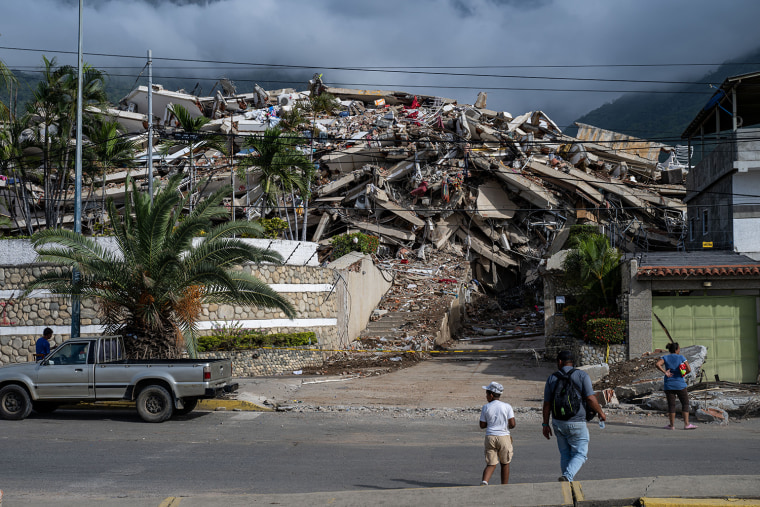
As of July 1, 2026, the efforts to aid victims of Venezuela’s catastrophic earthquakes are far from meeting the immense needs of those affected. The International Rescue Committee, a global humanitarian aid organization, highlighted the rapidly dwindling chances of survival for the tens of thousands still unaccounted for. The critical survival window of 72 hours has already passed, drastically reducing hopes for those still missing.
In a statement released on Tuesday, the IRC remarked, “The scale of the response does not meet the scale of humanitarian need.” According to reports from the interim government led by acting President Delcy Rodriguez, the disaster has resulted in at least 1,943 fatalities and thousands more injuries. An estimated 16,000 individuals find themselves without homes.
Data promoted by opposition groups in Venezuela estimates around 43,000 individuals remain missing. In La Guaira, the devastation is evident, with scenes of loss and mourning. At the area’s main port, now serving as a temporary morgue, Andrea Montilla waited to identify her 14-year-old cousin and his grandmother. Her cousin was recovered from the ruins of an apartment, but other family members, including her cousin’s mother, remain unaccounted for.
Coffins are seen stacked, while bodies in bags line the port’s concrete stretch. An anonymous official at the site noted that many workers have lost family members to the quakes, but could not confirm the number of bodies either identified or awaiting identification.
Despite the overwhelming devastation, a glimmer of hope emerged when Jordanian emergency workers rescued a child early on Tuesday. Unfortunately, this was the only reported survival on the sixth day following the disaster.
Efforts by rescue teams from countries like Ecuador and the United States were halted at a site in Macuto, La Guaira, when no further responses were received from a family of four trapped beneath a collapsed structure. Major Jorge Montanero, leading the Ecuadorian EQ11 team, stated, “What we will find now is death,” after extensive efforts to reach them had failed.
NASA estimates that approximately 59,000 buildings were either damaged or destroyed by the earthquakes, which hit with magnitudes of 7.2 and 7.5. Images capture the widespread damage, visible from space. In areas lacking professional rescue operations, residents and neighbors tirelessly worked to sift through debris to find survivors or retrieve bodies.
“There is no doubt we are facing a higher figure than currently reported,” said Gianluca Rampolla, the United Nations’ resident coordinator in Venezuela. “We are procuring 10,000 body bags, in agreement with local authorities.”
The United Nations has sounded alarms over potential crises such as hunger and disease following the earthquakes. The World Food Programme is seeking $50 million in funding to support up to 500,000 people with emergency food aid over three months. The agency stressed it could scale aid to 1 million individuals if sufficient resources become available.
The World Food Programme has already provided food supplies sufficient for a month, including cereals, beans, lentils, and vegetable oil, to around 1,200 people. Temporary feeding stations have also been established in La Guaira.
On Tuesday, the World Health Organization raised concerns about the strain on Venezuela’s healthcare infrastructure. At least three health facilities have suffered critical damage, with six others partially affected, limiting their capacity to serve the injured and ill.